


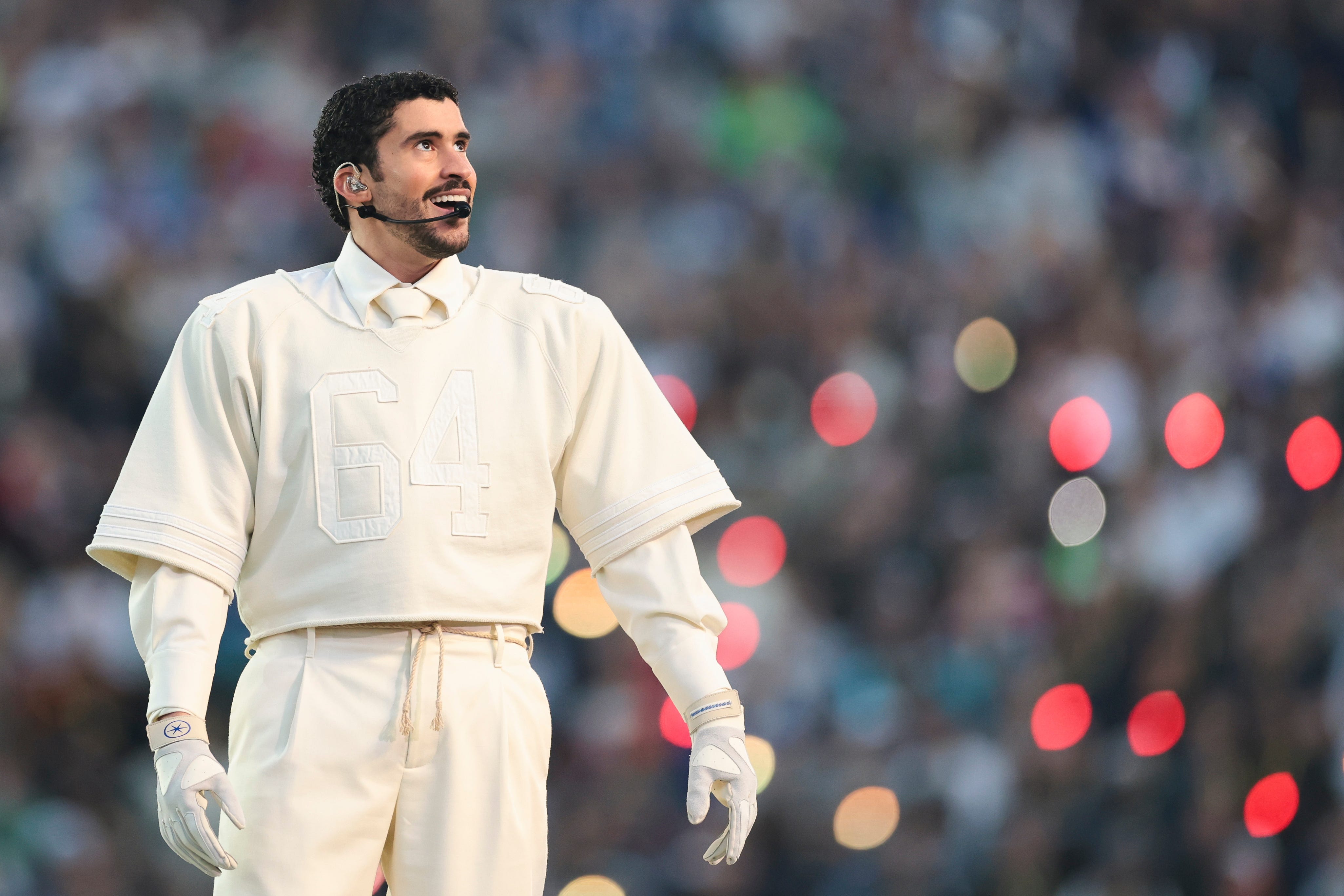
If you felt something, this is probably why
This past Sunday, like many, I showed up for the Benito Bowl more than I did for Super Bowl LX.
The halftime show, which took place at Levi’s Stadium in Santa Clara, California, on February 08, 2026, represented a pivotal moment for storytelling culture and change, which is why I wrote this piece.
We’ve been living in one of the most polarizing political climates of our time, one characterized by who belongs and by national borders, not just in the United States.
When Benito Antonio Martínez Ocasio, professionally known to the world as Bad Bunny, walked onto one of the biggest stages in America, he used a 13-minute broadcast, viewed by an estimated 135.4 million people, to tell us a story that centred the collective narratives of people defined by resistance and resilience. It played like a cinematic block party, and it also said so much more.
What we saw in Bad Bunny’s performance was a love letter to Puerto Rico and a masterclass in storytelling that critiqued colonialism, economic extraction, and the contested definition of who makes up the identity of America.
This was more than just a performance, where Bad Bunny became the first artist in history to headline a Spanish-language halftime show at the Super Bowl. It was a show that made history, as he used this platform to spark a much-needed public conversation about Puerto Rico’s relationship with the United States, reminding anyone who needed it that Puerto Rico has always been part of America, even though it has rarely been treated like it.
As someone who has been following Bad Bunny’s story as a fan but also as a documentarian who has covered topics at the intersections of culture and change across the Americas, I wanted to make sense of Benito’s visual storytelling that was showcased on the global stage.
So let’s break down five of the key moments to talk about how Bad Bunny spoke the loudest for cultural change.
1. Why the Show Began in a Sugarcane Field

The show began with a stage that symbolized and honoured Puerto Rico’s cultural history. The broadcast opened with an aerial shot of jíbaros (traditional Puerto Rican farmers) dressed in all white, working collectively in a sugarcane field. As the camera transitions to the live stage, we’re transported to an elaborate (and alive) set design built around towering sugarcane stalks, where Bad Bunny delivers his first visual storytelling anchor. The visuals of performing among the sugar cane fields were deliberate, a choice that TIME Magazine rightly described as a deliberate nod to Puerto Rico’s colonial past and economic exploitation.
Explainer: The Historical Context of the Sugar Economy in Puerto Rico
Sugarcane was introduced to Puerto Rico by Spanish colonizers in the 1500s and established the plantation systems that relied heavily on enslaved labour, which served the interests of European imperialism. For centuries, sugar has been the backbone of the island’s economy, with the wealth taken from local populations to support colonial empires. When Spain ceded Puerto Rico to the United States following the 1898 Treaty of Paris (which also ceded control of the Philippines, Guam and relinquished claims to Cuba), the sugar industry underwent a radical restructuring under American corporate control. American interests controlled nearly 98% of the island's sugar-processing capacity, and by 1930, 45% of all arable land in Puerto Rico had been converted into corporate sugar plantations.
So when Bad Bunny emerges from a set designed as a sugarcane field, it reframes the Super Bowl stage instantly with a subtle yet clear history lesson: Puerto Rico’s people and culture come from a land long controlled and exploited by colonialism. It was a reminder that Puerto Rico has always been “American” in the most inconvenient way: creating a culture that the world consumes, while living within an economic relationship that has too often treated the island more as a resource than as a people.
And that’s why the opening of Bad Bunny’s performance matters. A sugarcane field wasn’t just a set for the show; it’s a historical symbol of Puerto Rican culture of resilience against colonial extractive industries, which sets the stage for more.
2. What Number #64 on his Jersey Represented.
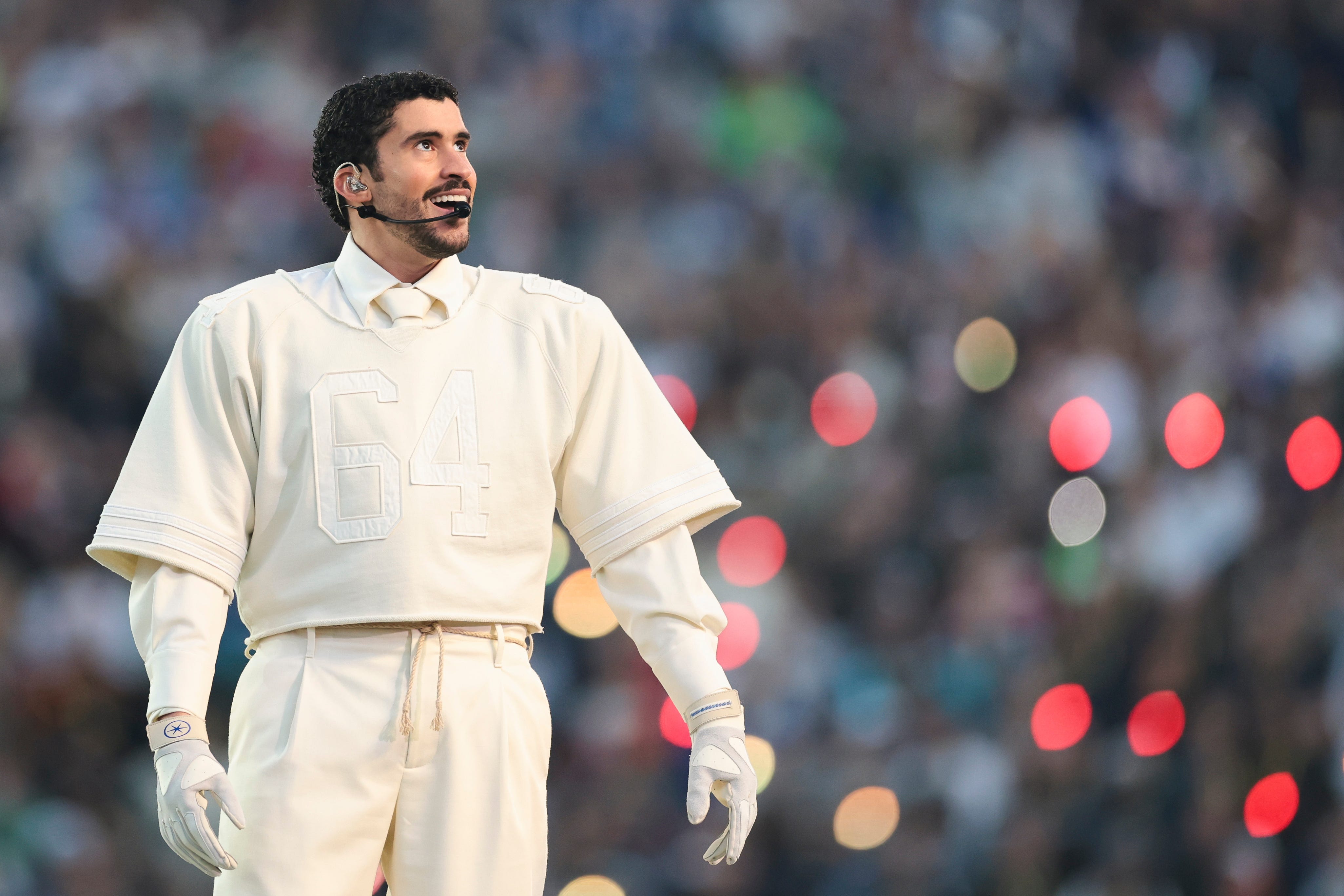
Bad Bunny walked out in an all-white football jersey fit. His last name, Ocasio, is across the back, and then 64 is embroidered on both the front and back. It’s a detail that had me wondering whether there was any symbolism, and that's what good storytellers do: they make people ask more questions. Here are two sides of what the interpretation of the number “64” could mean.
Personal Interpretations.
Fans have been widely speculating, with many pointing to the personal, noting that the number 64 references his mother’s birth year, 1964. You can hear Bad Bunny speak about his mom with heartfelt emotions in his Apple Music halftime show interview with Zane Lowe and Ebro Darden. He answered a question from a young person in the audience asking, “Who is someone that has always supported you and had a big impact in your life?”
I have to say my mom. She believed in me, and I’m not talking about my music career; I’m talking about before everything. She believed in me as a person, as a human. She believes in my decisions, my opinions, my taste, in my choices, and she believes that I could be a good person, smart guy, talented, and I think that’s what got me here.
Other outlets, including Complex, reported that the number “64” was a tribute to Bad Bunny’s late uncle, who played football wearing the same jersey number.
There is another interpretation that felt more connected to Bad Bunny’s overall conversation about Puerto Rico during the halftime show, in which the number 64 could be more politically pointed.
Political Interpretation and Its Connection to Hurricane Maria.
I first heard about it when tuning into New York Times Popcast, where host Joe Coscarelli discussed in their post-halftime show livestream, the symbolism behind the number “64,” which could likely be linked to the initial official death toll reported by the Puerto Rican government following the devastation of Hurricane Maria in September 2017.
PR’s government maintained this number for months despite evidence from people on the ground experiencing this in real time, like residents, journalists and local officials, who disputed that the loss of life was significantly higher due to the collapse of the power grid and failure of recovery efforts.
On The Numbers: An official study by George Washington University, which calculated deaths over a 6-month period, later raised the toll of lives lost as a result of the climate disaster to 2,975. An unofficial study led by Harvard T.H. Chan School of Public Health placed the toll closer to 4,645 based on household surveys and mortality rates.
The number 64 could very likely be a statement about how Puerto Rico has been treated in the aftermath of Hurricane Maria, where the lack of response and recovery efforts by the U.S. Federal Emergency Management Agency (FEMA) was widely criticized for its logistical failures.
At the time of this writing, it couldn’t be said with certainty that the jersey is a reference to the initial government death toll from Hurricane Maria, since there are no confirmed reports of this detail post-show.
What I can say is that Bad Bunny’s performance was already structured to highlight Puerto Rico’s story, and this number might very well have something to do with it, given that Bad Bunny has long been a popular voice calling out the government for inaction during Hurricane Maria.
The best storytelling allows an audience to go back and draw their own conclusions. We may be reading more into this, as fans, about the symbolism of 64, but wearing that jersey on the world stage forced people to ask questions they wouldn’t have asked before.
Story Update: Rolling Stone and other outlets confirmed on Monday, February 9th, that the jersey number he wore was for his late uncle, Cutito Ocasio. “I always dreamed of taking my uncle to a Super Bowl,” the Puerto Rican star said in a statement.
3. How A Flag Became An Act of Resistance.
During the transition to the song “El Apagón” (“The Blackout”), often heard as a call for Puerto Rico’s self-autonomy in an era of neocolonialism, Bad Bunny raised the Puerto Rican flag with a light-blue triangle. This was an intentional gesture which connects back to Puerto Rico’s history.
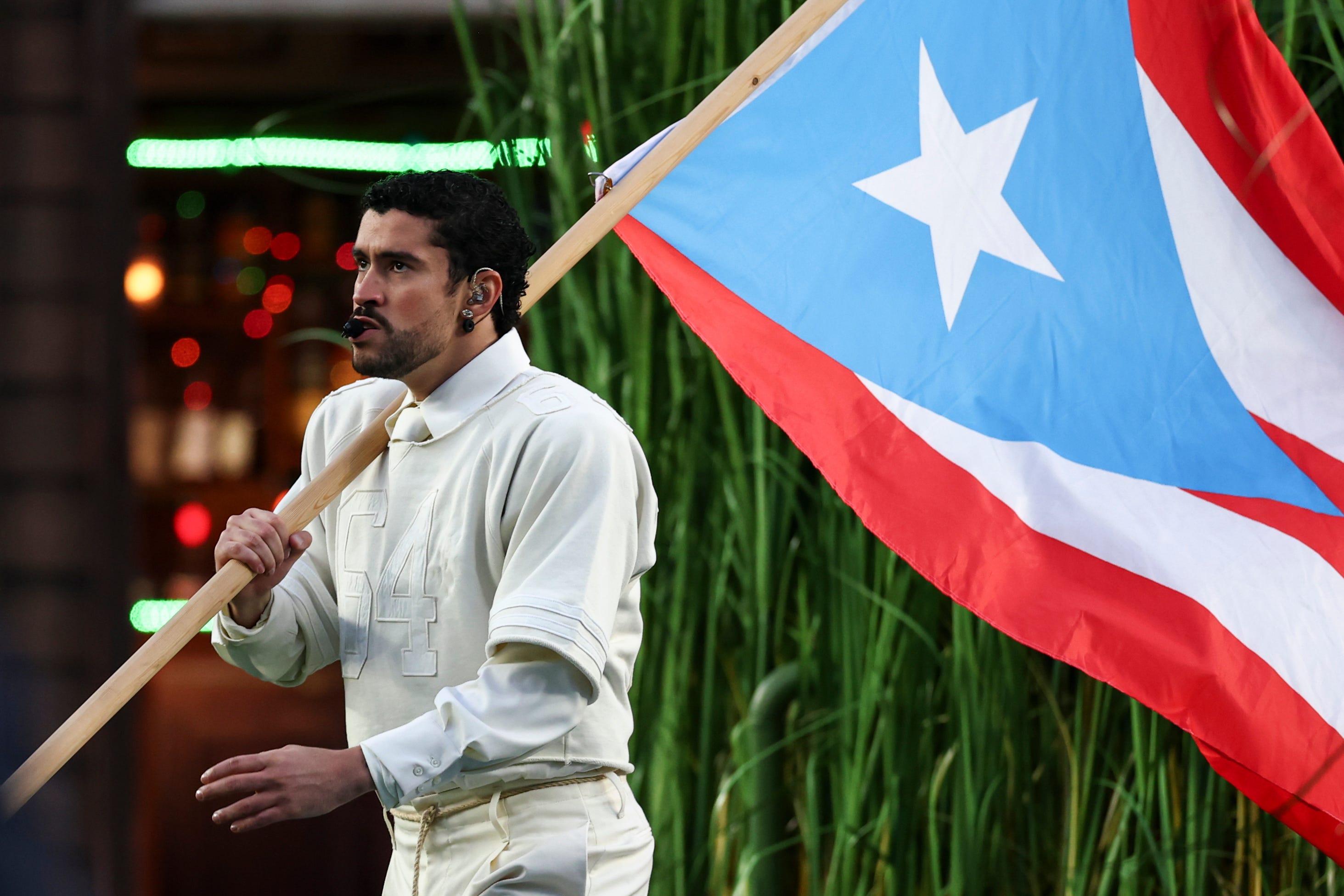
The history of the Puerto Rican flag is a story of resistance. The original design, created in 1895 by the Revolutionary Committee of Puerto Rico in New York, used a light-blue triangle to symbolize the sky and coastal waters, a choice influenced by the flag of the Grito de Lares, the first major revolt against Spanish rule in 1868. After the U.S. took control of the island, the flag became a symbol of resistance.
The U.S.-appointed legislature passed Law 53 in 1948, commonly known as the "Gag Law" (Ley de la Mordaza). This law criminalized pro-independence expression, which included owning or displaying a Puerto Rican flag, singing patriotic songs, or speaking in favour of independence, with penalties of up to 10 years in prison.
When Puerto Rico was granted Commonwealth status in 1952, the flag was legalized, but the shade of blue was changed to a dark navy to match the U.S. flag. The darkening of the flag was often seen as an attempt to strip it of its revolutionary connotations and align it with American sovereignty. The light-blue-triangle version of Puerto Rico’s flag today is widely seen and used as a symbol of the island’s independence movement.
The flag associated with Puerto Rico’s independence movement made for one of the strongest political statements in the halftime show and was easy to miss if you’re not familiar with PR’s history. What made this such an important moment in the show was that it was a coded detail for people who understood what the flag meant. Bad Bunny, carrying the flag of the independent movement, was more than a silent protest; it sparked a conversation about self-determination for Puerto Rico and echoed a defiant stance against government censorship.
Additional Context: The scene itself opened up with a cameo and generational handoff from another Puerto Rican pop legend, Ricky Martin, who performed Bad Bunny’s “Lo que le pasó a Hawaii” (“What happened to Hawaii”), a song from Bad Bunny’s “DeBÍ TiRAR MáS FOToS” (DtMF) album, drawing parallels between Puerto Rico and Hawaii, two islands that have been largely shaped by U.S. power and tensions around control. The chorus of the song speaks to themes of cultural erasure and gentrification, with lyrics stating that they don’t want to see what happened to Hawaii happen to Puerto Rico as well.
4. When the Power Grid Became the Plot
The set design for “El Apagón” (“The Blackout”) took the ongoing messaging about PR’s self-autonomy and made it clear why: as jíbaros danced on top of electric utility poles while their transformers flared and sparked. This was a visual representation symbolizing the power failure and frequent blackouts that have plagued Puerto Rico since Hurricane Maria.
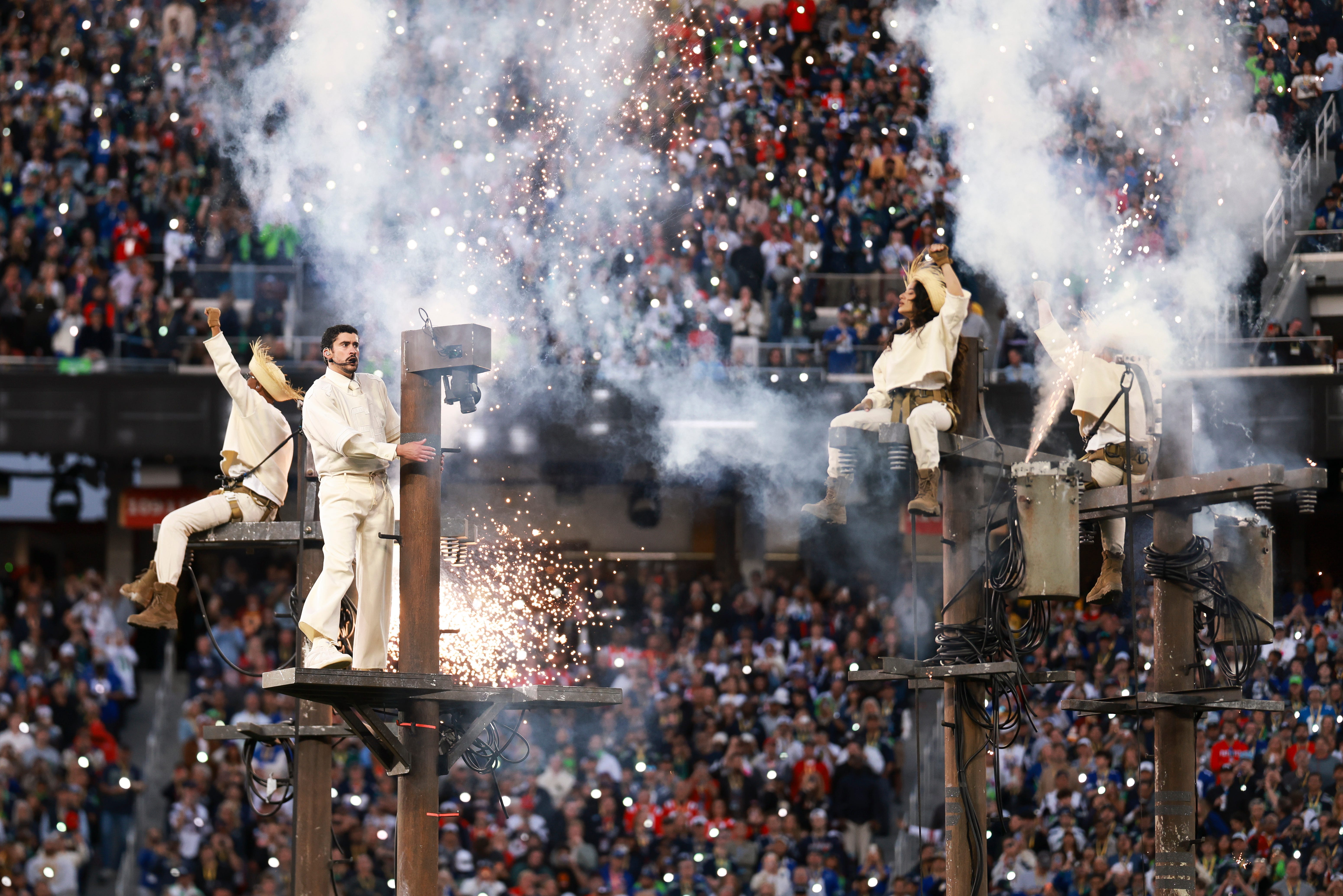
The music video for “El Apagón” incorporated an 18-minute documentary titled Aquí Vive Gente (People Live Here), which brought to life the frequent power cuts in Puerto Rico. The video features commentary and reporting from Puerto Rican journalist Bianca Graulau on everyday life under recurring outages and the politics of energy on the island.
The Context of Electricity and Energy Privatization in Puerto Rico
In June 2021, the distribution and transmission of electricity in Puerto Rico was transferred to LUMA Energy, a private firm. Despite promises of improved service, the island has faced a series of massive outages, rising costs, and a deteriorating electricity grid, leading to widespread protests. The power failures didn’t start with LUMA; Puerto Rico’s Electric Power Authority (PREPA) had struggled with chronic blackouts since the aftermath of Hurricane María and has also been criticized for corruption and mismanagement.
While El Apagón is already known as an artistic response to the privatization of Puerto Rico’s power, Bad Bunny’s performance of the song can be seen as a critique of governance that prioritizes private profit over the interests of Puerto Ricans. Notably, it’s also the second time we see the jíbaros in the performance, this time working on the electricity poles as a modern-day equivalent of the sugarcane stalks.
Once you understand the context of this, the finale hits differently.
5. The Finale of Who Counts as “America.”
An honourable and heartwarming moment worth mentioning in Bad Bunny’s performance came before the Ricky Martin verse & El Apagón performance, but felt best to include here.
It was when a young kid appeared on set, watching a clip of Bad Bunny’s recent Grammy win. Bad Bunny then approaches the kid and hands him a Grammy award. It was a moment that felt symbolic of passing the torch to the next generation, and Variety later confirmed that it depicted a young Benito in his childhood.
It's moments like these throughout Bad Bunny’s performance that we see his empowerment of everyday people, and in the finale, we see the show's most important collective storytelling moment yet.
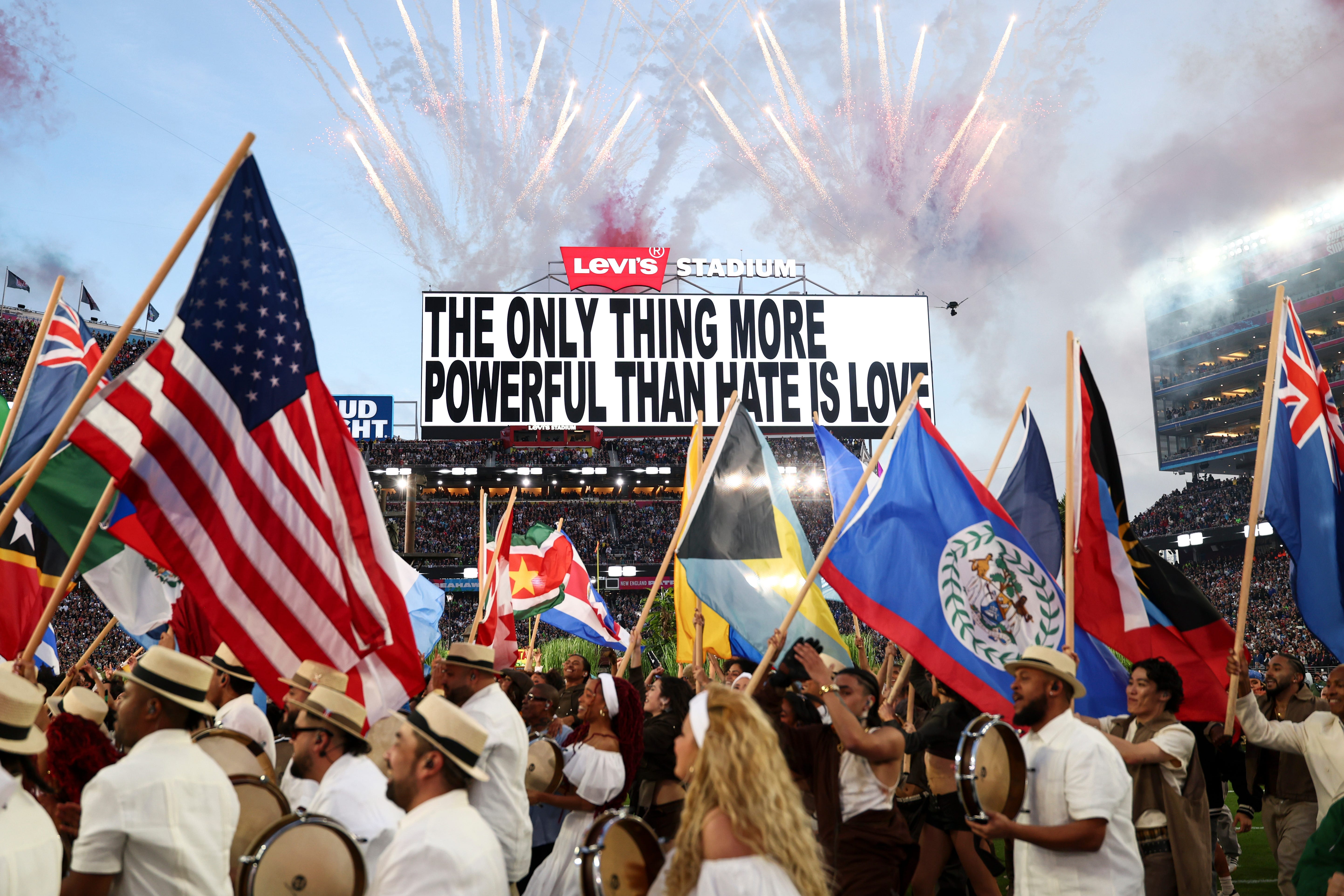
For his final act, we see flag bearers racing through the field as Bad Bunny shouts out ¡Que Dios bendiga a América!” (“God Bless America!”). The stadium scoreboard lights up with a line that Bad Bunny voiced at the Grammys just a week prior.
“The only thing more powerful than hate is love.”
He continues his performance by naming every country and territory from South and Central America, including the Caribbean and Canada. With each name called, the flag bearers of all the countries named created a procession of who truly makes up America. He capped his performance by spiking a football towards the camera with a message inscribed on it
“Together We Are America.”
This moment matters because culture, immigration, and national identity are among the most emotionally charged points of conflict, not just in America but around the world, including in Canada, as populism polarizes political divisions against everyday people.
The artistry of Bad Bunny’s storytelling during the halftime show made it clear that America is part of a hemisphere of many people coming together.
Bad Bunny’s performance was not only a love letter to Puerto Rico, putting the island on the world stage, but also a statement of diversity, inclusivity, and hope for many people who have been hurting in these trying times.
Why this story matters now.
Bad Bunny won multiple awards at this year's Grammy for his work behind the album DeBÍ TiRAR MáS FOToS (DtMF), and was the first artist to ever have a Spanish-language record win album of the year.
DtMF has sparked a cultural awakening, putting Puerto Rico on the world stage long before this year’s Super Bowl. His residency in the capital, San Juan, last year generated an estimated 400 million in revenue for PR’s local economy. Bad Bunny’s decision to forgo a traditional U.S. tour in favour of the San Juan residency was a political and economic statement. Citing concerns over immigration enforcement and the safety of his Latino fans, he made the world come to Puerto Rico.
While Bad Bunny has never been shy about making political statements about ICE and standing up to protest against government inaction in Puerto Rico’s recovery efforts after Hurricane Maria, his halftime show performance thrust him further in the spotlight as an artist who has and will continue to create significant cultural change and needed social commentary for the world through his music.
Bad Bunny didn’t use the Super Bowl to make a statement. He used it to tell a story and that’s why it hit.
I’m writing this story not as someone who is a Boricua (Puerto Rican), and it is important to note that there were so many more cultural symbols that Bad Bunny referenced in his performance, which I could not fully cover due to time, but were just as important as they made everyday people, different cultures, and most importantly, Puerto Ricans feel seen and acknowledged.
I can't speak for Puerto Rico. But I have seen what it looks like when a place is expected to give the world beauty while it fights for basics. Watching Bad Bunny’s halftime show was emotional; it moved me to write this story and reflect on the power of storytelling to create change. In 2018, I visited Puerto Rico with my partner, nine months after Hurricane Maria had impacted the entire island. What we saw was a beautiful island of people, with a complex colonial history and a modern one still reeling from one of the worst climate disasters of its time.
Bearing witness to the challenges there pushed me to continue documenting and telling more stories about culture, our climate, and change in hopes of creating a more connected world through our shared narratives.
I’m writing about this topic because stories of change can be told in many ways. My hope is that this article helps you better understand how social change is told and influenced through culture and narratives.
Bad Bunny has been a growing cultural force and global icon who has made change by moving people to rethink who truly belongs on stage, and through that, he has sent a strong message to the world, letting those who have felt left behind know:
Seguimos Aqui (We’re Still Here)
If you have a story tip, especially on community solutions, climate stories or cultural shifts worth paying attention to, you can reach me at sid@changemade.co.
Authors’ Note: I’ve spent the last two days since the halftime show reviewing reporting & publications, curating licensed images, and fact-checking interpretations as they emerged to produce this longer-form deep dive into the visual storytelling of Bad Bunny’s Super Bowl halftime show performance.
If you want to see more independent visual journalism through The Change Made, consider becoming a subscriber, as all work on this platform is self-funded. I post dispatches twice a week and sometimes more when a story like this deserves it.
I’m also sharing sources & further reading from this article to support more knowledge building on the topics I write about. It’s an additional resource I’m making available to the community.
Sources & Recommendations for Further Reading / Listening:
Watch New York Times Popcast: Breaking Down Bad Bunny’s Super Bowl Halftime Show: A Puerto Rican History Lesson
Watch Bad Bunny - El Apagón - Aquí Vive Gente (Official Video / Docu) | Un Verano Sin Ti (Spanish)
Reading: The Battle For Paradise: Puerto Rico Takes on the Disaster Capitalists by Naomi Klein
Reading: P FKN R: How Bad Bunny Became the Global Voice of Puerto Rican Resistance (Available Feb 24, 2026)
Follow: Journalist Bianca Graulau for independent reporting insights on Puerto Rico
Incredible. 🔥